


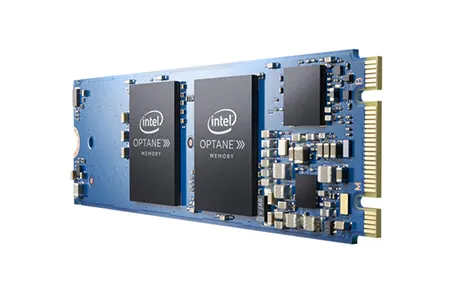
Intel – the best-known name in the field of processor production for computers – presented and released Optane memory to the market in early 2017.
It is something like a cross between RAM and a SSD hard disk, and is a new category of memory units offering speed, density and stability.
At the moment it is available only in units of 16GB and 32GB, but it is believed that in the future high-capacity SSD Optane will be released that will replace the classic SSD.
Intel Optane memory is a new category of memory units offering speed, density and stability
The technology behind Optane
Intel Optane uses memory based on 3D Xpoint technology, where the memory cells are arranged in a three-dimensional grid. It is offered by Intel in combination with other technologies and software of its own, in order to achieve a very short delay in transferring information and data (even as low as 10 microseconds).
To Optane exploits its pioneering technology to store a large amount of data in a very small area, while also offering very fast access to that data.

In Intel Optane the memory cells are arranged in a three-dimensional grid
Intel Optane memory in the form in which it is released on the market today (as a M.2 card) is cache memory that acts as a bridge between RAM memory and the storage medium (hard disk) and makes possible faster data transfer between them and the processor. This speeds up all the user's tasks, especially when Optane is combined with suitable software that works "smartly" and stores the most relevant data on it for immediate access.
System requirements for Intel Optane
For Optane to work, the system on which it will be installed must meet certain requirements. The processor must be Intel 7th generation with chip core (Kaby Lake), that is core i3, i5, i7, and the motherboard must be compatible with this technology.
In general Optane is compatible with all RAM, graphics cards and storage media that can work with the computer's motherboard. It works only with Windows 10, and it is not yet known whether it will work with MacOS or Linux.

Intel Optane requires a Intel 7th-generation processor (Kaby Lake) and a compatible motherboard, and is compatible with all RAM, graphics cards and storage media that work with that motherboard
What does Optane offer the user?
Optane memory is a small piece of very fast memory that increases the performance and speed of the computer's primary storage medium, that is, the hard disk that contains the operating system.
It cannot replace RAM memory and cannot be used as a hard disk.
It is not necessary for the computer to operate, but it can speed it up significantly. In tests published by Intel itself, Optane appeared to boost the overall performance of a computer with a Intel 7th generation processor by 28%, while games load 67% faster and browsers open 5 times faster.
Unlike RAM, Optane is non-volatile memory, that is, it does not lose the data stored on it when the computer is turned off, and it has better quality of operation, since its performance very rarely deviates.
Intel Optane is expected to be used widely in servers and in cloud services, since it can perform many more tasks per second without its performance dropping. It is also expected to find use in scientific research, where it is important to have as much working memory available as possible.

Intel Optane requires a Intel 7th-generation processor (Kaby Lake) and a compatible motherboard, and is compatible with all RAM, graphics cards and storage media that work with that motherboard
Is it the ideal solution for everyone?
Optane is an ideal choice for those who want to use a single large-capacity HDD disk, instead of a smaller-capacity but faster SSD. When Optane is combined with a classic HDD hard disk, the computer's performance and speed improve significantly, and its performance is equal to or even better than if it had a fast SSD disk.
When we talk about a system with two disks, an SSD and a mechanical one, where the operating system is stored on the SSD, you will not see a big difference with Optane, since when it is combined with an SSD disk the improvement in performance and speed is not so impressive.
In general Intel Optane technology is very new and is expected to find more and more uses and applications in the future.
The important thing is that all the major manufacturers have announced that they will release models of both desktop computers and laptops with Intel Optane, so we will soon get to know it up close.
All the major manufacturers have already released, or plan to release in the future, laptops and desktop computers with Intel Optane


